Amphipholis squamata (Delle Chiaje, 1828)
AphiaID: 125064
AphiaID: 125064
Biota (Superdominio) > Animalia (Reino) > Echinodermata (Filo) > Asterozoa (Subfilo) > Ophiuroidea (Classe) > Myophiuroida (Subclasse) > Metophiurida (Infraclasse) > Ophintegrida (Superordem) > Amphilepidida (Ordem) > Gnathophiurina (Subordem) > Amphiuroidea (Superfamilia) > Amphiuridae (Familia) > Amphipholis (Genero)
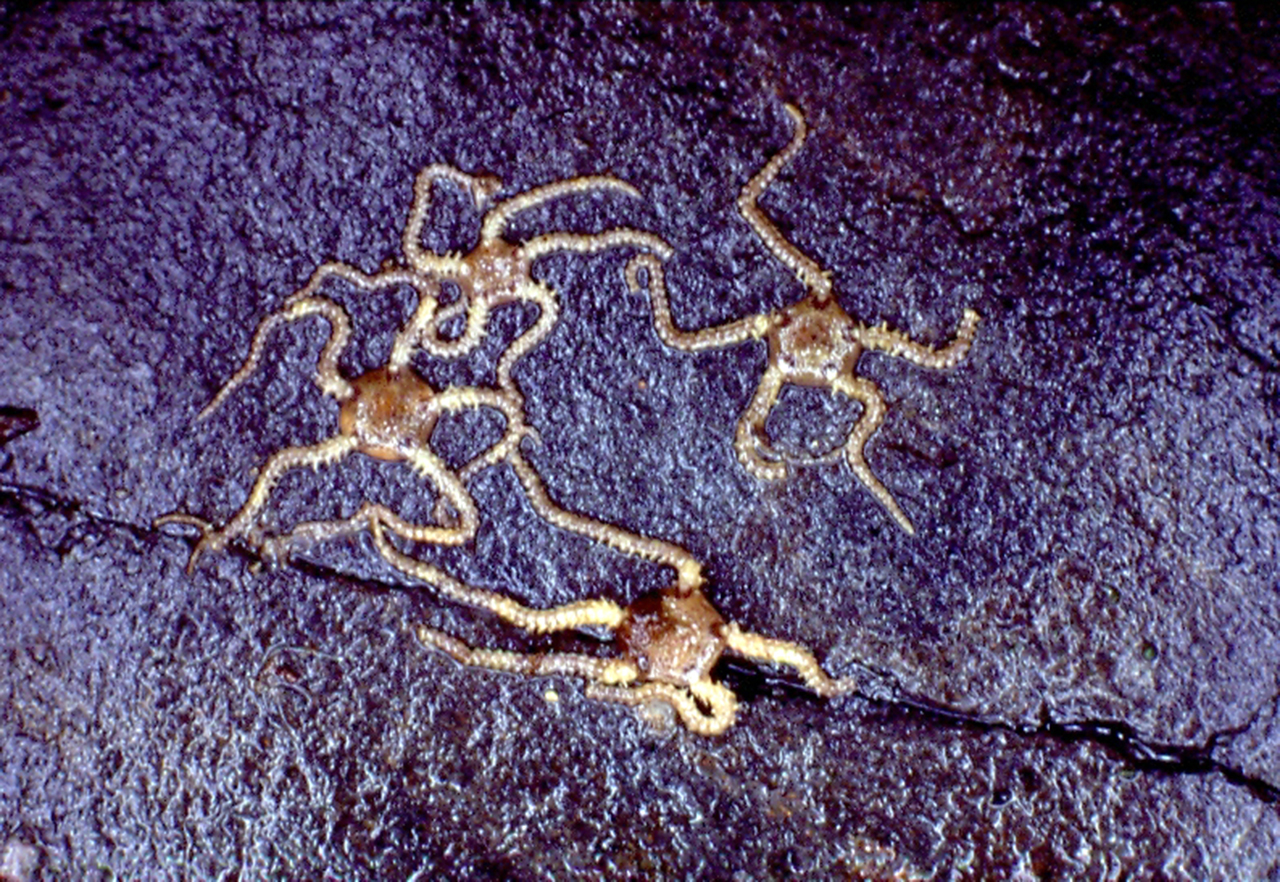
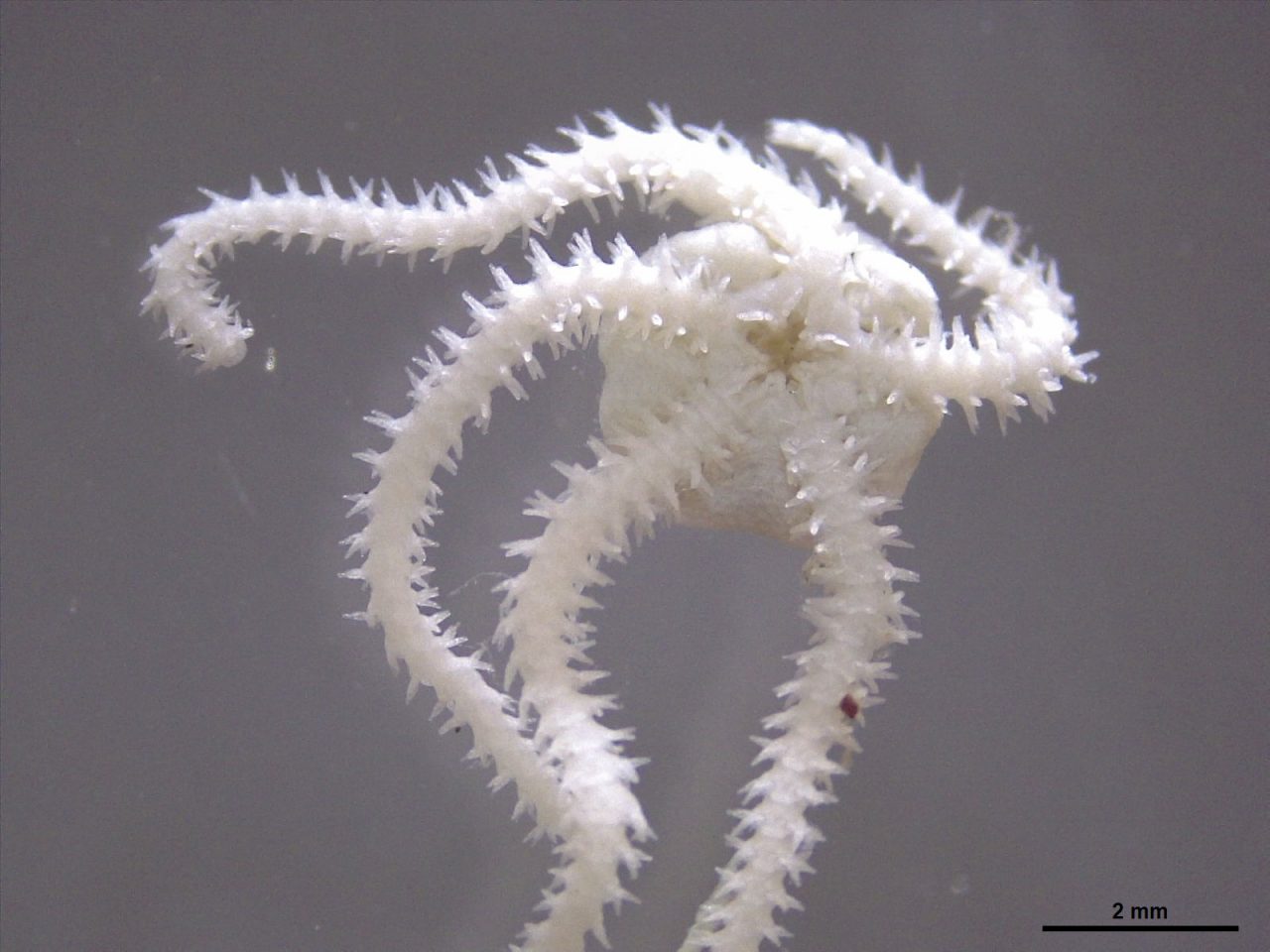
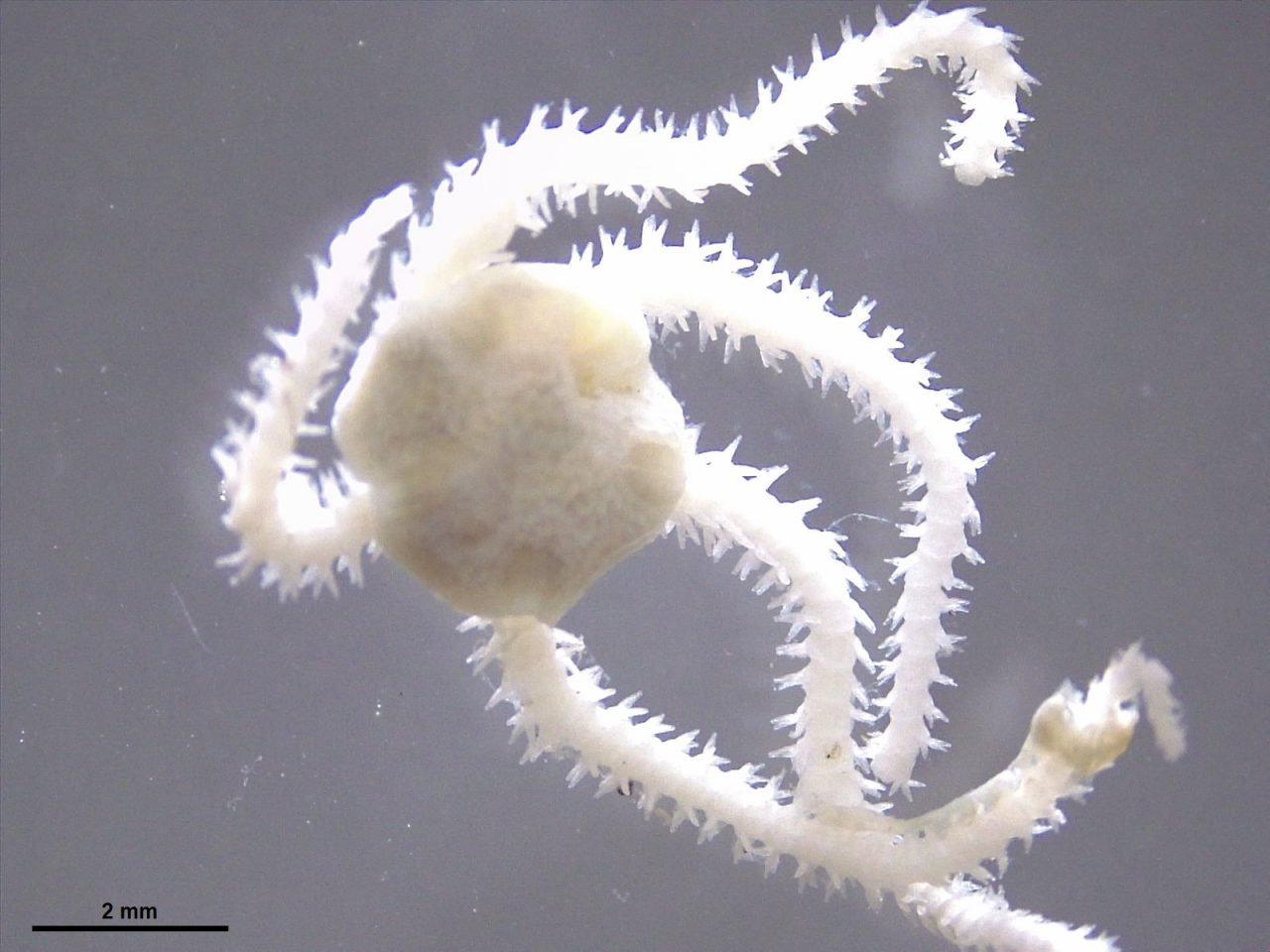
Corpo com disco central até 5 mm de diâmetro e cinco braços de cerca de quatro vezes esse comprimento (até 20 mm de comprimento); de cor acinzentada ou branca azulada. Disco coberto em ambos os lados por escamas bastante pequenas; os escudos radiais são pequenos, com cerca de 1/3 de raio discal e contíguos em todo o comprimento. Espécie luminescente.
Espécie cosmopolita em zonas de águas temperadas e temperadas a quentes.
Encontra-se frequentemente na região intertidal até profundidades de cerca de 250 m, entre algas, briozoários, em águas pouco profundas e debaixo de conchas ou pedras.
Alimenta-se de partículas orgânicas existentes nos sedimentos e de partículas que se encontram em suspensão.

Ophiura neglecta Johnston, 1835
Pesquise mais sobre Amphipholis squamata > ~ sealifebase ~ Marine Species Identification Portal ~Habitas ~ MarLIN ~Biorede
MADEIRA P.; KROH A.; CORDEIRO R.; MARTINS A. & ÁVILA S. (2019) The Echinoderm Fauna of the Azores (NE Atlantic Ocean) 231 pp.; Magnolia Press, New Zealand (https://biotaxa.org/Zootaxa/article/view/zootaxa.4639.1.1/49235)
Rowley, S.J. 2006. Amphipholis squamata Small brittle star. In Tyler-Walters H. and Hiscock K. (eds) Marine Life Information Network: Biology and Sensitivity Key Information Reviews, [on-line]. Plymouth: Marine Biological Association of the United Kingdom. Available from: https://www.marlin.ac.uk/species/detail/2071
Picton, B.E. & Morrow, C.C. (2016). Amphipholis squamata (Chiaje, 1829). [In] Encyclopedia of Marine Life of Britain and Ireland. http://www.habitas.org.uk/marinelife/species.asp?item=ZB3000
additional source Hansson, H. (2004). North East Atlantic Taxa (NEAT): Nematoda. Internet pdf Ed. Aug 1998., available online at http://www.tmbl.gu.se/libdb/taxon/taxa.html [details]
basis of record Hansson, H.G. (2001). Echinodermata, in: Costello, M.J. et al. (Ed.) (2001). European register of marine species: a check-list of the marine species in Europe and a bibliography of guides to their identification. Collection Patrimoines Naturels,. 50: pp. 336-351. [details]
additional source Gosner, K. L. (1971). Guide to identification of marine and estuarine invertebrates: Cape Hatteras to the Bay of Fundy. John Wiley & Sons, Inc. 693 p. [details]
additional source Linkletter, L. E. (1977). A checklist of marine fauna and flora of the Bay of Fundy. Huntsman Marine Laboratory, St. Andrews, N.B. 68: p. [details]
additional source Pollock, L.W. (1998). A practical guide to the marine animals of northeastern North America. Rutgers University Press. New Brunswick, New Jersey & London. 367 pp., available online at http://books.google.com/books?id=i1AmT31cuR4C [details]
additional source Clark, A.M. (1977). The South African Museum’s Meiring Naude cruises, part 4: Echinoderms. Ann. S. Afr. Mus. 73(6):; 133-147. [details]
additional source Clark, A.M. & Courtman-Stock, J. (1976). The echinoderms of southern Africa. Publ. No. 766. British Museum (Nat. Hist), London. 277 pp. [details]
additional source Southward, E.C.; Campbell, A.C. (2006). [Echinoderms: keys and notes for the identification of British species]. Synopses of the British fauna (new series), 56. Field Studies Council: Shrewsbury, UK. ISBN 1-85153-269-2. 272 pp. [details]
additional source Muller, Y. (2004). Faune et flore du littoral du Nord, du Pas-de-Calais et de la Belgique: inventaire. [Coastal fauna and flora of the Nord, Pas-de-Calais and Belgium: inventory]. Commission Régionale de Biologie Région Nord Pas-de-Calais: France. 307 pp., available online at http://www.vliz.be/imisdocs/publications/145561.pdf [details]
original description Delle Chiaje S. (1823-1831). Memorie sulla storia e notomia degli animali senza vertebre del regno di Napoli. Napoli: Fratelli Fernandes (vol. 1), and Società Tipografica (vol. 2-4). Vol. 1, pp. i-xii, 1-84 [1823], pp. 1-184 [1824]; vol. 2, pp. [1-4] + 185-224 [1825], pp. 225-444 [1826]; vol. 3, pp. i-xx, pp. 1-232 [1828]; vol. 4, pp. i-vii [1831], 1-116 [1830], pp. 117-214 [1831]; pl. 1-4; pl. 1-69 [date?], pl. 70-109 [1830][dates according to Sherborn, 1922]., available online at https://doi.org/10.5962/bhl.title.10021 [details]
additional source Mah, C.L.; McKnight, D.G.; Eagle, M.K.; Pawson, D.L.; Améziane, N.; Vance, D.J.; Baker, A.N.; Clark, H.E.S.; Davey, N. (2009). Phylum Echinodermata: sea stars, brittle stars, sea urchins, sea cucumbers, sea lilies. In: Gordon, D.P. (Ed.) (2009). New Zealand inventory of biodiversity: 1. Kingdom Animalia: Radiata, Lophotrochozoa, Deuterostomia. pp. 371-400. [details]
status source Hendler, G.; Peck, R.W. 1988. Ophiuroids off the deep end: Fauna of the Belizean fore-reef slope. In: Burke, R.D.; Mladenov, P.V.; Lambert, P.; Parsley, R.L. Echinoderm Biology, Proceedings of the sixth International Echinoderm Conference, 411-419. [details]
additional source Pawson, D. L., D. J. Vance, C. G. Messing, F. A. Solis-Marin & C. L. Mah. (2009). Echinodermata of the Gulf of Mexico. Pp. 1177–1204 in Felder, D.L. and D.K. Camp (eds.), Gulf of Mexico–Origins, Waters, and Biota. Biodiversity. Texas A&M Press, College S. [details]
additional source Liu J.Y. [Ruiyu] (ed.). (2008). Checklist of marine biota of China seas. China Science Press. 1267 pp. [details]
additional source Trott, T. J. (2004). Cobscook Bay inventory: a historical checklist of marine invertebrates spanning 162 years. Northeastern Naturalist. 11, 261-324., available online at http://www.gulfofmaine.org/kb/files/9793/TROTT-Cobscook%20List.pdf [details]
context source (Deepsea) Intergovernmental Oceanographic Commission (IOC) of UNESCO. The Ocean Biogeographic Information System (OBIS), available online at http://www.iobis.org/ [details]
context source (HKRMS) Wai, H.Y. (2009) Effects of Deployment of Artificial Reefs on the Marine Benthic Environment, with Special Reference to Sediment Physico-Chemical Chanracteristics. MPhil thesis. City University of Hong Kong. [details]
additional source Gosner, K. L. (1971). Guide to identification of marine and estuarine invertebrates: Cape Hatteras to the Bay of Fundy. John Wiley & Sons, Inc. 693 p. [details]
additional source Pollock, L.W. (1998). A practical guide to the marine animals of northeastern North America. Rutgers University Press. New Brunswick, New Jersey & London. 367 pp., available online at http://books.google.com/books?id=i1AmT31cuR4C [details]
additional source Clark, A.M. & Courtman-Stock, J. (1976). The echinoderms of southern Africa. Publ. No. 766. British Museum (Nat. Hist), London. 277 pp. [details]
additional source Southward, E.C.; Campbell, A.C. (2006). [Echinoderms: keys and notes for the identification of British species]. Synopses of the British fauna (new series), 56. Field Studies Council: Shrewsbury, UK. ISBN 1-85153-269-2. 272 pp. [details]
additional source Pawson, D. L., D. J. Vance, C. G. Messing, F. A. Solis-Marin & C. L. Mah. (2009). Echinodermata of the Gulf of Mexico. Pp. 1177–1204 in Felder, D.L. and D.K. Camp (eds.), Gulf of Mexico–Origins, Waters, and Biota. Biodiversity. Texas A&M Press, College S. [details]
context source (BeRMS 2020) Aquatic environment and quality group; Flanders research institute for agriculture, fisheries and food (ILVO), Belgium; (2017): Subtidal macrobenthos monitoring in function of a foreshore suppletion at the Belgian coast, period 2013-2016. [details]
additional source Gosner, K. L. (1971). Guide to identification of marine and estuarine invertebrates: Cape Hatteras to the Bay of Fundy. John Wiley & Sons, Inc. 693 p. [details]
additional source Pollock, L.W. (1998). A practical guide to the marine animals of northeastern North America. Rutgers University Press. New Brunswick, New Jersey & London. 367 pp., available online at http://books.google.com/books?id=i1AmT31cuR4C [details]
additional source Clark, A.M. & Courtman-Stock, J. (1976). The echinoderms of southern Africa. Publ. No. 766. British Museum (Nat. Hist), London. 277 pp. [details]
additional source Southward, E.C.; Campbell, A.C. (2006). [Echinoderms: keys and notes for the identification of British species]. Synopses of the British fauna (new series), 56. Field Studies Council: Shrewsbury, UK. ISBN 1-85153-269-2. 272 pp. [details]
additional source Pawson, D. L., D. J. Vance, C. G. Messing, F. A. Solis-Marin & C. L. Mah. (2009). Echinodermata of the Gulf of Mexico. Pp. 1177–1204 in Felder, D.L. and D.K. Camp (eds.), Gulf of Mexico–Origins, Waters, and Biota. Biodiversity. Texas A&M Press, College S. [details]
additional source Liu, J.Y. [Ruiyu] (ed.). (2008). Checklist of marine biota of China seas. China Science Press. 1267 pp. [details]
additional source Clark, A. M. (1977). The South African Museum’s Meiring Naude cruises, part 4: Echinoderms. Ann. S. Afr. Mus. 73(6):; 133-147. [details]
additional source Hansson, H. G. (1998). NEAT (North East Atlantic Taxa): Scandinavian Echinodermata Check-List (Comp.). , available online at https://www.gu.se/sites/default/files/2020-10/NEAT%2AEchinodermata.pdf [details]
context source (PeRMS) Solís-Marín, F. A.; Alvarado, J. J.; Abreu-Pérez, M.; Aguilera, O.; Alió, J.; Bacallado-Aránega, J. J.; Barraza, E.; Benavides-Serrato, M.; Benítez-Villalobos, F.; Betancourt-Fernández, L.; Borges, M.; Brandt, M.; Brogger, M. I.; Borrero-Pérez, G. H.; Buitrón-Sánchez, E.; Campos, L. S.; Cantera, J.; Clemente, S.; Cohen-Renjifo, M.; Coppard, S.; Costa-Lotufo, L. V.; del Valle-García, R.; Díaz, Y.; Díaz de Vivar, M. E.; Díaz-Martínez, J. P.; Durán-González, A.; Epherra, L.; Escolar, M.; Francisco, V.; Freire, C. A.; García-Arrarás, E.; Gil, D. G.; Guarderas, P.; Hadel, V. F.; Hearn, A.; Hernández, J. C.; Hernández-Delgado, E. A.; Herrera-Moreno, A.; Herrero-Pérezrul, M. D.; Hooker, Y.; Honey-Escandón, M. B. I.; Lodeiros, C.; Luzuriaga, M.; Manso, C. L. C.; Martín, A.; Martinez, M. I.; Martínez, S.; Moro-Abad; Mutschke, E.; Navarro, J. C.; Neira, R.; Noriega, N.; Palleiro-Nayar, J. S.; Pérez, A. F.; Pérez-Ruzafa, A.; Prieto-Rios, E.; Reyes, J.; Rodríguez, R.; Rubilar, T.; Sancho-Mejía, T.; Sangil, C.; Silva, J. R. M. C.; Sonnenholzner, J. I.; Ventura, C. R.; Tablado, A.; Tavares, Y.; Tiago, C. G.; Tuya, F.;Williams, S. M. (2013). Appendix. In: J. J. Alvarado & F. A. Solís-Marín (eds), Echinoderm Research and Diversity in Latin America. pp. 471-510. Springer; Berlin & Heidelberg. page(s): 543-654. [details]

O texto desta página é disponibilizado nos termos da licença Creative Commons - Atribuição 4.0 Internacional (CC BY 4.0); pode estar sujeito a condições adicionais, para mais detalhes consulte os Termos e Condições.